

18 min read
.png)
Are you drowning in paper, battling endless customer calls, or painstakingly cross-referencing accounts with a ruler? Many public sector utility officials like you face a constant struggle to balance accurate billing with efficient operations and exceptional customer service. You're working tirelessly to serve your community! But outdated processes or software can make that mission feel impossible.
We’ve spent decades working alongside public utility teams, seeing firsthand the frustrations of manual systems and the relief that comes with real, sustainable solutions. Our approach is simple: radical honesty, transparency, and a commitment to answering your toughest questions about utility billing. We believe that by providing clear, actionable insights, we can help you navigate the complexities of utility management, reduce your headaches, and ultimately become the most trusted and efficient utility in your region.
In this blog post, we’re going to tackle the most pressing questions we hear from utility leaders just like you. We’ll cut through the jargon and give you straightforward answers that can transform your operations. By the end, you’ll have a clearer roadmap for overcoming your biggest billing challenges.
How Can Public Sector Utilities Improve Billing Accuracy and Reduce Manual Errors?
Let's be blunt: manual billing processes are a breeding ground for errors. You know the drill. Someone manually enters a meter reading, then someone else manually calculates the charge, and then a third person double-checks it all. This isn't just inefficient; it's a constant source of frustration and, frankly, customer complaints. When you're manually double-checking accounts with a ruler or trying to decipher handwritten notes, accuracy is always at risk.
The truth is, even the most meticulous human makes mistakes, especially when dealing with thousands of accounts. These errors lead to incorrect bills, which inevitably lead to disgruntled customers and more calls to your already busy customer service line. Worse, they can result in lost revenue for the utility or overcharging your community members, which erodes trust.
So, how do we fix this? The fundamental shift lies in automation. Think about what happens when you implement automated meter reading (AMR) or advanced metering infrastructure (AMI). Readings are captured digitally, often wirelessly, and flow directly into your billing system. This eliminates manual data entry errors at the source. Automated systems can also cross-reference data, flag discrepancies, and calculate complex rate structures without human intervention.
For example, imagine a system that automatically flags an unusually high usage spike for a residential account. Instead of just billing it, the system alerts a team member to investigate. This proactive approach can catch a leak early, prevent a massive bill that shocks the customer, and turn a potential complaint into an opportunity to provide excellent service.
Accuracy is a way to build confidence both internally for your team and externally with your customers. When your bills are consistently accurate, your team spends less time correcting mistakes and more time serving customers. And your customers trust that they're paying exactly what they owe; no more, no less.
What Are the Best Strategies for Streamlining Utility Bill Processing and Workflow?
Paper processes are the silent killer of efficiency in many public sector utilities. Stacks of paper bills, physical filing cabinets, and the constant need to shuffle documents from one desk to another create bottlenecks. (And let's not even talk about the potential for wind!) And there's printing costs, too. But most importantly, it all adds up to the immense amount of time your staff wastes on administrative tasks that could be automated. Every paper invoice that needs to be manually sorted, every payment that needs to be manually posted, slows down your entire operation.
Streamlining your utility bill processing and workflow starts with a commitment to going digital. This means moving away from paper and embracing solutions that automate repetitive tasks.
Here are some key strategies:
-
Digital Billing & Payments: Offer customers options for e-billing and online payment portals. This reduces the need for printing, mailing, and manually processing checks. Many customers prefer this anyway.
-
Automated Data Flow: Ensure that data moves seamlessly from meter reading to billing, and then from payments to your accounting system. This means integrating different software solutions so they "talk" to each other.
-
Workflow Automation: Identify repetitive, rule-based tasks in your billing cycle and look for ways to automate them. This could include automated overdue notices, service disconnection alerts, or even payment plan management.
-
Centralized Data Management: Having all customer and billing data in one easily accessible system means your team isn't hunting for information across different spreadsheets or physical files. This significantly speeds up inquiry resolution.
Think about the impact of even a small change! If your team spends just 10 minutes less per day on manual paper handling because of a digital process, that's over 40 hours saved per employee per year. That time can be redirected to higher-value tasks, like proactive customer outreach, goodwill campaigns, or service improvements.
How Can Utility Companies Enhance Customer Service and Reduce Call Volume Related to Billing Inquiries?
"My bill is too high!" "I don't understand these charges!" "Why was my service disconnected?"
Sound familiar? Frequent customer service calls related to billing inquiries are a massive drain on resources for public utilities. Your customer service representatives are often overwhelmed, trying to explain complex charges or resolve disputes that stem from unclear bills or a lack of accessible information.
The core of reducing these calls lies in transparency and self-service. When customers can easily find their bill, understand it, and find answers to their questions on their own, they won't need to call you.
Here's how to achieve that:
-
Clear, Understandable Bills: Design your utility bills to be intuitive. Use plain language, clear graphics, and break down charges so they're easy to comprehend. Avoid jargon that only an insider would understand.
-
Robust Online Customer Portals: This is perhaps the most impactful strategy. A good customer portal allows customers to:
-
View their current and past bills.
-
Track their usage history (often with charts and graphs).
-
Make payments securely.
-
Set up payment plans or autopay.
-
Access FAQs and educational resources about their service. When customers have 24/7 access to their information, many common questions are answered without a phone call.
-
-
Proactive Communication: Use automated notifications for bill due dates, payment confirmations, and even high usage alerts. This reduces "surprise" bills and provides timely information.
-
Empower Your CSRs: Equip your customer service team with quick access to all customer and billing data. When they can instantly pull up a customer's history, explain charges clearly, and offer solutions, calls are resolved faster and more effectively.
-
Offer Training Videos: Create a video that shows customers exactly how to understand their bill or pay their bill online. Then share it on social media, your website, or even YouTube. This is especially important for younger generations.
-
Use Chat and Voice AI: Companies, like our partner Polimorphic, offer the capability of a Chatbot on your website and a Voice AI via phone to answer customer questions at any time of day. They're secure, easy to use, and respond in a nearly-human manner.
For example, per Polimorphic's website, Andy Pederson, the Village Manager at Village of Bayside, Wisconsin said this: “AI Search [Chatbot] provides a user-friendly experience to navigate the website's content and knowledge, used internally by staff and externally by residents... With the institutional knowledge lost with retiring employees, AI has been a way to fill in the gaps.”
And Intashan Chowdhury, Borough Administrator at Prospect Park, NJ said the following: "We’ve been getting positive feedback about VoiceAI because it helps educate the public on how to maneuver through municipal services. So we have seen a significant reduction in terms of foot traffic in Borough Hall. This allows staff to focus on those who need assistance the most."
Give it a test drive. Call 202-980-2202 and ask:
-
How do I get a building permit & what is the cost?
-
When will my trash be picked up?
-
Can you answer my question in Spanish?
It’s all about shifting from reactive problem-solving to proactive information-sharing.
What Technology Solutions Can Transform Public Sector Utility Billing Operations?
We’ve touched on it, but it’s worth diving deeper. The right technology is a game-changer for public sector utility billing. Many smaller entities are still relying on legacy systems or even manual spreadsheets that simply can't keep up with modern demands. And modernizing is a necessity for efficiency, accuracy, and customer satisfaction.
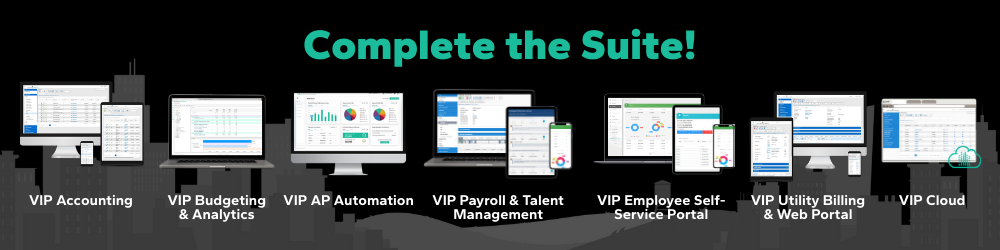
The primary technology solution we're talking about here is modern utility billing software. It's an integrated platform that manages everything from meter data and consumption calculations to customer accounts, payments, and reporting.
Key features of transformative utility billing software include:
-
Automated Meter Data Management: Seamlessly imports and processes data from various meter types (electric, water, gas, waste).
-
Flexible Rate & Fee Management: Handles complex, multi-tiered rate structures, special discounts, and various fees with ease, ensuring accurate calculations for every customer.
-
Integrated Customer Relationship Management (CRM): Keeps all customer interactions, service requests, and communication history in one place.
-
Comprehensive Payment Processing: Supports multiple payment methods (online, auto-pay, in-person, phone), reconciles payments, and integrates with accounting systems.
-
Reporting & Analytics: Provides robust tools to generate reports on revenue, consumption, customer trends, and operational efficiency.
-
Cloud-Based Accessibility: For public sector utilities, a cloud-based solution offers flexibility, scalability, and enhanced data security without the need for extensive on-site IT infrastructure. Your team can access it from anywhere, which is incredibly helpful for remote work or field technicians.
Choosing the right system involves looking beyond just the features. You need a partner who understands the unique needs of public sector utilities. The regulatory environment. The community focus. The budget constraints. The public accounting needs.
The Finance Director at Georgetown Municipal Water & Sewer Services in Kentucky said this of VIP Utility Billing: "We have found that training new employees is easier. The system is more intuitive and has a tremendous amount of information available from one screen. The active links allow us to drill down and through to every associated record, making fact-finding and problem-solving much faster and more accurate. The ability to go to any period and print reports means we no longer have stacks of paper to be filed at the end of every cycle."
How Do We Efficiently Manage Deceased Customer Accounts and Final Billing?
Managing deceased customer accounts is a sensitive and often cumbersome process for public utilities. It involves more than just turning off service; it requires navigating legal requirements, communicating with grieving families, and ensuring that final bills are accurate and handled with respect. This specific pain point can be incredibly time-consuming when relying on manual checks and fragmented information.
An efficient process for deceased accounts often involves several steps, and technology can significantly ease the burden:
-
Notification & Verification: Establish a clear process for receiving death notifications (e.g., from family, funeral homes, public records). A robust billing system should allow for easy flagging of the account.
-
Service Transition/Disconnection: Determine if service needs to be transferred to a new occupant, temporarily maintained, or disconnected. The system should facilitate this change smoothly.
-
Final Meter Reading & Billing: Obtain a final meter reading as close as possible to the date of death or service cessation. Generate a final bill, clearly indicating it's for an estate.
-
Estate Communication & Payment: Identify the appropriate party responsible for the estate (executor, next of kin). Send the final bill to the correct address and provide clear instructions for payment. A modern system can automate the generation of these specific notices.
-
Account Closure & Archiving: Once the final payment is received (or written off, if necessary), the account needs to be officially closed and archived for record-keeping, ensuring no further charges are generated.
The key here is having a system that allows for easy tagging of accounts, clear communication trails, and automated generation of final statements to the correct parties. It's about combining administrative efficiency with a compassionate approach during a difficult time for your community members. It also frees up valuable staff time that would otherwise be spent manually tracking these complex, often sensitive, accounts.
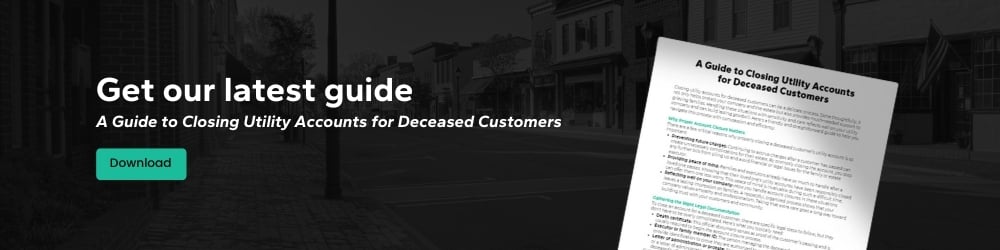
It's so important that we've even written A Guide to Closing Utility Accounts for Deceased Customers. Download it here.
What Are the Financial Benefits of Modernizing Utility Billing Systems?
For Finance Directors and Utility Managers, the idea of investing in new technology can seem daunting. But the reality is that modernizing your utility billing system is not only an operational improvement; it's a significant financial investment with a rapid return. The cost of "doing nothing" (continuing with inefficient, error-prone manual processes) is often far higher than the cost of modernization.
Let’s break down the financial benefits:
-
Reduced Operational Costs:
-
Lower Labor Costs: Automation reduces the need for manual data entry, double-checking, and paper handling, freeing up staff for higher-value tasks or even allowing for staff reallocation.
-
Decreased Printing & Mailing: Digital billing and online portals drastically cut down on paper, envelopes, and postage expenses.
-
Fewer Payment Processing Fees: Encouraging online payments and autopay can sometimes reduce transaction costs compared to processing physical checks.
-
-
Improved Revenue Collection:
-
Enhanced Accuracy: Fewer billing errors mean fewer adjustments, less lost revenue from underbilling, and more accurate financial forecasting.
-
Faster Payment Cycles: Streamlined billing and easier payment options lead to quicker payments from customers, improving cash flow.
-
Reduced Arrears: Automated reminders and flexible payment options can lower the amount of outstanding debt.
-
-
Better Resource Allocation: When your team isn't bogged down by administrative tasks, they can focus on strategic initiatives, infrastructure improvements, or community programs. This is where your utility can truly add value beyond just billing. Value for the future of the company.
-
Reduced Compliance Risk: Modern systems often have built-in features to help you meet regulatory requirements, which can prevent costly fines or legal issues. And you can avoid ransomware attacks, which can cost you hundreds of thousands of dollars.
While a precise ROI depends on your specific situation, many public utilities find that the cost savings and revenue improvements achieved through modernization pay for the initial investment surprisingly quickly.
We even wrote an entire blog about it. Read it here.
What Are the Regulatory Compliance Requirements for Public Sector Utility Billing?
Public sector utilities operate under a unique set of rules and regulations. It obviously involves financial reporting. But it also encompasses consumer protection, data privacy, and sometimes specific state or local mandates regarding billing practices. Staying compliant manually is a heavy lift, making it easy to accidentally fall short.
Modern utility billing systems are designed with these compliance needs in mind. They help you:
-
Maintain Accurate Records: Digital records are easily auditable and can be stored securely for the required retention periods.
-
Ensure Data Security: Protecting sensitive customer data (names, addresses, payment information) is paramount. Robust systems include encryption, access controls, and regular backups to safeguard this information against breaches.
-
Adhere to Billing Standards: Many jurisdictions have rules about bill format, dispute resolution processes, and notice periods for service changes or disconnections. Good software can be configured to comply with these specific requirements.
-
Support Transparent Practices: Regulations often push for transparency in billing. Modern systems help you clearly itemize charges and provide historical usage data, empowering customers to understand their bills.
Failing to comply can lead to significant penalties, reputational damage, and a loss of public trust. A compliant system minimizes these risks, giving utility officials peace of mind and allowing them to focus on service delivery rather than worrying about regulatory pitfalls.
How Can Data Analytics Improve Decision-Making in Public Utility Billing?
For years, public utilities have been sitting on a goldmine of data without the tools to unlock its value. Your billing system collects vast amounts of information every day: meter readings, payment histories, customer service interactions, and usage patterns. When this data is trapped in silos or on paper, it's just raw numbers. But when it's integrated into a modern system with analytics capabilities, it becomes powerful insights.
Data analytics transforms reactive management into a proactive strategy. Instead of just seeing what happened last month, you can understand why it happened and predict what might happen next.
Here’s how data analytics can improve decision-making:
-
Usage Pattern Analysis: Identify trends in consumption across different customer segments or geographic areas. This can help with resource planning, demand forecasting, and even identifying potential infrastructure issues (like widespread leaks).
-
Revenue Forecasting: More accurately predict future revenue based on historical billing data, usage trends, and seasonal variations. This is invaluable for budget planning and financial stability.
-
Customer Behavior Insights: Understand payment habits, identify customers at risk of arrears, or pinpoint areas where billing explanations might be unclear, leading to frequent calls.
-
Operational Efficiency Insights: Analyze billing cycle times, error rates, and payment processing bottlenecks to continually refine and improve your internal processes.
-
Targeted Outreach: Use data to identify specific groups of customers who might benefit from conservation programs, payment assistance, or specific educational materials.
Imagine being able to see, at a glance, that water usage in a particular neighborhood has spiked by 20% over the last quarter, far exceeding typical seasonal changes. This insight, gleaned from your billing data, could prompt an investigation into a potential leak or an educational campaign on water conservation, preventing much larger issues down the line.
What Steps Are Involved in Migrating to a New Utility Billing System?
The thought of migrating to a new utility billing system can feel overwhelming. It’s a significant undertaking, and many public sector officials worry about disrupting service, losing data, or facing unforeseen costs. But just like any major infrastructure project, with proper planning and a clear roadmap, it’s entirely manageable.
Here are the typical steps involved in migrating to a new system:
-
Assessment & Planning: This is the foundational step. You'll define your current pain points, identify your specific needs and goals for the new system, establish a budget, and form a project team. It’s important to involve key staff from different departments (billing, finance, IT, customer service).
-
Vendor Selection: Research and evaluate potential software vendors. Look for companies with proven experience in the public sector, a strong understanding of utility billing, and a track record of successful implementations. Request demos and references.
-
Data Migration: This is arguably the most critical and complex step. Your historical customer data, meter readings, billing history, and payment information need to be accurately transferred from your old system (or paper records) to the new one. This often involves data cleansing and validation.
-
System Configuration: The new software needs to be configured to match your specific rate structures, billing cycles, customer types, and regulatory requirements. This is where your unique operational nuances are built into the system.
-
Integration with Other Systems: If you use separate accounting software, GIS systems, or meter reading devices, the new billing system needs to seamlessly integrate with them to ensure smooth data flow across your operations.
-
Testing: Thoroughly test every aspect of the new system – from meter reading import and bill generation to payment processing and customer portal functionality. Run parallel tests with your old system for a period to ensure accuracy.
-
Training: Your staff, especially those in billing and customer service, will need comprehensive training on how to use the new system. Effective training is key to user adoption and preventing post-launch issues.
-
Go-Live & Post-Launch Support: The exciting (and sometimes nerve-wracking) moment when you switch to the new system. Ensure you have dedicated support from your vendor during this critical period for any immediate issues.
For example, here's the roadmap we give to new customers:
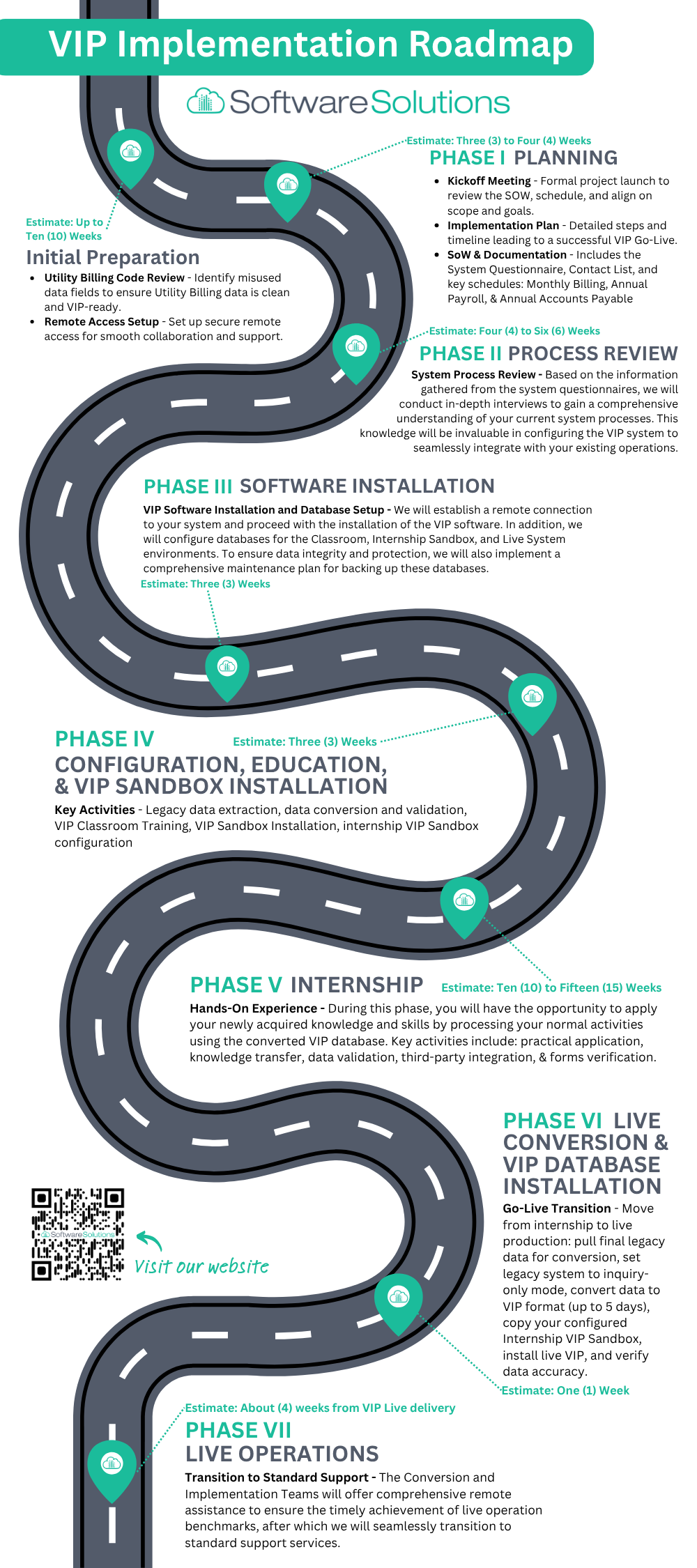
While the process requires effort, the long-term benefits in terms of efficiency, accuracy, and improved customer service far outweigh the temporary challenges of migration. A good vendor acts as a true partner, guiding you through each stage and minimizing disruption.
Why Should Public Sector Utilities Prioritize Trust and Transparency in Billing?
In the public sector, your relationship with the community is paramount. Utility bills are often one of the most frequent interactions citizens have with their local government. Because of this, trust and transparency in billing are foundational to your reputation and your ability to effectively serve the public.
When customers don't understand their bills, or when they perceive inaccuracies, trust fades. And rates always end up going up, which does not please customers either. This leads to more complaints, slower payments, and a generally strained relationship between the utility and the community it serves. Radical honesty, as we see it, means preemptively answering customer questions, even before they ask them.
Here’s why prioritizing trust and transparency matters:
-
Enhanced Customer Satisfaction: Clear, accurate bills that are easy to understand reduce confusion and frustration. When customers feel informed, they feel respected.
-
Reduced Disputes & Calls: As we discussed, transparent billing leads to fewer questions and disputes, freeing up your customer service team.
-
Improved Payment Compliance: Customers are more likely to pay their bills promptly when they trust that the charges are fair and accurate.
-
Stronger Community Relations: A trusted utility is a valued asset to the community. It fosters goodwill and makes it easier to implement new initiatives or gain support for necessary rate adjustments.
-
Compliance with Public Expectation: Public utilities have a higher standard of accountability. Citizens expect their government entities to be open and clear about how their money is being spent.
-
Community Support: When customers understand why prices are being raised, the cost of certain services and infrastructure, and the public accounting process, they will be more amenable. A lot of complaining comes from misunderstandings or ignorance. You can fix both proactively.
Transparency means providing easy access to usage history, explaining rate structures in simple terms, and being upfront about any changes to service or charges. It’s building a reputation as a utility that prioritizes its customers, not just its bottom line. It's truly about becoming the most known and trusted utility in your space. And earning the respect and confidence of your community members.
Ready to Transform Your Utility Billing Operations?
You're dealing with immense pressure to improve efficiency, reduce costs, and enhance customer satisfaction, all while navigating complex regulations. The good news is that solutions exist to move beyond the paper, the manual checks, and the endless customer calls. Modern utility billing systems offer a clear path to greater accuracy, streamlined workflows, and a more transparent, trustworthy relationship with your community.
We’ve seen firsthand how public sector utilities, just like yours, have shifted from frustrating manual processes to efficient, automated systems that empower their teams and delight their customers. The future of utility billing is integrated, data-driven, and focused on trust. Read some case studies here.
Don’t let outdated processes hold your utility back any longer. We’ve recently hosted a webinar designed specifically for public sector utility officials, where we dove deeper into utility problems and solutions and share practical steps you can take today. Watch it here.
Related Posts
Solving Utility Issues with Experts
You’re grappling with an unpredictable postal service, the rising tide of check fraud, and the...
Exploring Incentive Programs for Utilities
The utility industry is changing fast. Communities across the country are pushing for...
Cutting Days of Exposure to Boost Utility Revenue and Efficiency
Having too many Days...