

23 min read
.png)
Governmental accounting can feel like its own language.
You hear words like funds, accrual, cash basis, fiduciary, liability, revenue journals, and T accounts, and suddenly a simple transaction starts looking like it needs a translator, a spreadsheet, and maybe a snack.
But at its core, governmental accounting exists for one very practical reason: public money has to be tracked, restricted, reported, and used for the purpose it was collected for.
That’s what makes it different from traditional business accounting. A private company is usually focused on profitability and financial performance. A public-sector organization is focused on accountability, compliance, transparency, and stewardship of public funds.
And for cities, villages, counties, utilities, libraries, townships, parks, schools, and special districts, understanding that difference is important. Especially when your billing, payroll, purchasing, deposits, credit memos, and accounting entries all work together behind the scenes.
In this blog post, we’ll break down the basics of governmental accounting, including how public funds are tracked, why fund accounting is important, how cash and accrual accounting differ, and how everyday transactions can affect reporting and reconciliation.
First Things First: The Terms
Before we get into the nitty-gritty details of governmental accounting, let’s define a few terms.
-
General ledger: The main accounting record where financial activity is organized. Think of it as the official accounting book.
-
Account: A category used to track money. For example, cash, utility revenue, payroll expense, customer deposits, or accounts receivable.
-
Journal entry: A record that shows how a transaction affects the general ledger. One customer payment may affect cash, revenue, receivables, or liabilities, depending on the accounting method.
-
Accounts receivable: Money owed to the organization but not yet collected. For example, a utility bill that has been sent but not paid.
-
Accounts payable: Money the organization owes to someone else.
-
Recognize revenue: To officially record income in accounting records.
-
Reconciliation: The process of comparing two records to make sure they match. For example, checking that utility billing totals match the general ledger.
What is the Difference Between Governmental Accounting and Financial Accounting?
Traditional financial accounting focuses on profitability and financial performance, while governmental accounting centers on accountability, compliance, and tracking restricted public funds through fund accounting to show money is used as intended.
Traditional financial accounting focuses heavily on financial health.
-
Is the business profitable?
-
Are expenses controlled?
-
Are shareholders, owners, investors, and creditors seeing the performance they expect?
Governmental accounting is different.
Public-sector organizations still care deeply about financial stability. Nobody wants to run at a deficit year after year. But the primary focus is not profit. It’s accountability.
Governmental accounting answers questions like:
-
Was the money used for its intended purpose?
-
Was the revenue recorded correctly?
-
Are public funds being tracked separately?
-
Can the organization show transparency to taxpayers, voters, boards, councils, auditors, and oversight agencies?
-
Are reports compliant with state and federal requirements?
That’s why governmental accounting uses fund accounting.
What is fund accounting? Fund accounting is the method governments use to track money that comes with legal or donor-imposed restrictions. Instead of measuring success by profit, it centers on accountability by separating resources into self-balancing buckets, or funds, which helps organizations track where money belongs and use it for the purpose it was intended to support.
In a public-sector environment, money often comes with rules attached. Water revenue should be used for water-related purposes. Electric revenue should support electric operations. Restricted grant funds should be used according to the grant requirements. Fund accounting organizes money so that you know where each cent needs to go.
In other words, public money usually can’t be treated like one big checking account.
Tempting? Maybe.
Allowed? Not so much.
Why is Fund Accounting Important?
Fund accounting separates money by purpose so governments and utilities can track different types of funds, confirm that each dollar is used appropriately, and direct transactions correctly in their software.
A government or utility may have multiple funds, each tied to a different activity, revenue source, or restriction. This separation helps organizations track where money came from, where it went, and whether it was used appropriately.
Common fund categories include:
Governmental funds
These support traditional government functions and are often funded through taxes. Examples may include the general fund (charges for service, fines and forfeitures, and business licenses, building permits, zoning fees, etc.), parks and recreation, street funds, capital project funds, as well as taxes.
Proprietary or enterprise funds
These operate more like business-type activities because they are funded by user charges. Utility billing is a common example. Water, sewer, electric, garbage, and similar services often fall into this category.
Fiduciary or custodial funds
These are funds the organization holds for another purpose or party. Utility deposits are a good example. The money may be held by the organization, but it isn’t necessarily “the organization’s money” in the same way operating revenue is.
That distinction is key when transactions happen in your software.
Because when a payment is received, a deposit is applied, or a credit memo is refunded, the system has to know what kind of money it is dealing with and where that money should go.
The Three Main Accounting Methods
Government entities may use different accounting methods depending on state requirements, organization type, fund type, and reporting needs.
The three main methods we'll discuss today are:
1. Cash Basis Accounting
Cash basis accounting is the simplest method.
Revenue is recognized when cash is received. Expenses are recognized when cash is paid out.
Think of it like a checkbook. Money comes in. Money goes out. The transaction is recorded when the cash actually moves.
For many smaller public-sector organizations, especially in states that allow cash basis accounting for certain entities, this method can be easier to manage day-to-day.
But simple doesn’t mean careless.
Even in cash basis accounting, transactions still need to be categorized correctly. Funds still matter. Revenue still has a purpose. And reconciliation still requires clean setup and consistent processes.
2. Accrual Basis Accounting
Accrual accounting recognizes revenue and expenses when they are earned or incurred, not necessarily when cash changes hands.
So if a utility bills a customer, the revenue may be recognized when the bill is created. If an organization orders or receives goods or services, the expense may be recognized before the payment is actually made.
Accrual accounting gives a more comprehensive view of financial activity because it includes receivables, payables, assets, and liabilities.
But it also adds complexity.
A single transaction can trigger multiple accounting entries. And those entries may affect accounts receivable, cash, revenue, liability accounts, expense accounts, and more.
This is why accrual accounting requires strong configuration, clear labels, and staff who understand what the system is doing behind the scenes.
3. Modified Accrual Accounting (or sometimes Modified Cash Basis Accounting)
Modified Accrual combines pieces of both approaches.
Revenue and expenses may still be recorded largely on a cash basis, but the organization may also track additional items like depreciation, inventory, or other accrual-style activity.
It’s more detailed than pure cash accounting, but not as comprehensive as full accrual.
What Are GAAP and GASB?
If you’re new to governmental accounting, you may hear people talk about GAAP and GASB. They sound like alphabet soup, but they’re important.
GAAP stands for Generally Accepted Accounting Principles. These are the standard accounting rules and practices organizations follow so financial reports are consistent, reliable, and easier to compare.
For state and local governments, those standards come from GASB, the Governmental Accounting Standards Board. GASB sets GAAP for state and local governments in the United States, but the way they get applied can look a little different depending on state laws, reporting systems, and oversight agencies.
GAAP is the rulebook. GASB writes the governmental accounting rules in that rulebook.
This is because government financial reports are used by taxpayers, elected officials, auditors, bondholders, grant agencies, oversight boards, and the public. The goal is not just to show whether money came in and went out. The goal is to show whether public money was handled responsibly, reported clearly, and used for the right purpose.
Not every government reports the exact same way in day-to-day operations. Some smaller entities may operate on a cash or modified cash basis depending on their state’s requirements. But GAAP and GASB still shape how governmental financial reporting is understood, audited, and discussed across the public sector. GASB’s standards and guidance provide access to U.S. GAAP for state and local governments.
What are the Basic Accounting Elements or Financial Statement Components of Governmental Accounting?
Most accounting activity can be understood by looking at the basic parts involved:
-
Cash - Money the organization has on hand or in bank accounts that is available to spend now.
-
Revenue - Income the organization earns from taxes, charges for services, grants, or other sources.
-
Expense - Costs the organization incurs to operate and provide services (payroll, utilities, supplies, etc.).
-
Assets - Resources the organization owns or controls that have value, such as cash, receivables, buildings, vehicles, or equipment.
-
Liabilities - Amounts the organization owes to others, like loans, accounts payable, or customer deposits.
In a cash-basis environment, organizations typically focus most heavily on cash, revenue, and expense.
In an accrual-basis environment, assets and liabilities come into play, too.
What Is the Difference Between Debits and Credits in Accounting?
In accounting, debits and credits work differently than they do in banking because whether they increase an account depends on the account type. Debits increase cash, assets, and expenses; credits increase revenue and liabilities. T accounts are more of a basic learning or teaching tool to help show how both sides of an entry work together and where something may have gone out of balance.
For non-accounting staff, the words debit and credit can be confusing because they don’t always mean what people think they mean from banking.
In accounting, whether a debit or credit increases an account depends on the type of account. A T account is just a simple way to show where money moved. The left side is called the debit side. The right side is called the credit side. Depending on the type of account, one side increases the balance and the other decreases it.
Generally:
-
Debits increase cash, assets, and expenses.
-
Credits increase revenue and liabilities.
So a debit is not automatically “bad,” and a credit is not automatically “good.” They are simply the two sides of an accounting entry.
Every balanced transaction needs both.
This is why T accounts are useful, though perhaps a bit dated and simple. A T account is a simple visual tool that shows how money moves between accounts when you’re learning. It helps you map what should increase, what should decrease, and whether the full entry makes sense.
-png.png?width=1000&height=250&name=Support%20Site%20Banners%20(1)-png.png)
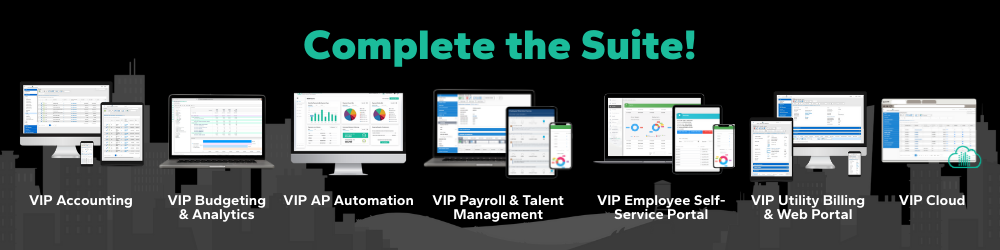
How Governmental Accounting Applies Across the VIP Suite
Governmental accounting does not live in one department.
It touches nearly every major financial process inside a public-sector organization, including accounting, utility billing, payroll, purchasing, budgeting, reporting, and document generation.
Across the VIP Suite, the same core questions show up again and again:
-
What fund should this transaction affect?
-
Has the money been earned yet?
-
Is this cash, revenue, an expense, an asset, or a liability?
-
Should this create a journal entry?
-
Does the accounting treatment change under cash basis or accrual basis?
-
Will this affect reconciliation later?
Once you understand those questions, the software starts to make more sense.
A utility payment may affect cash, revenue, receivables, or liabilities. A payroll run may distribute wages, taxes, benefits, deductions, and retirement contributions across funds or departments. An invoice approval may affect accounts payable, expenses, budgets, and supporting documentation. A budget report may rely on accurate activity from multiple areas of the system.
Different processes. Same financial foundation.
The goal is not just to complete a task in one module. It’s to help each transaction connect back to the organization’s financial records in a way that supports accuracy, accountability, reporting, and audit readiness.
That’s why staff outside the finance office benefit from understanding the basics. Utility billing, payroll, HR, and purchasing teams do not need to become accountants, but they should understand when their actions may affect the general ledger.
A void, reversal, refund, deposit application, payroll correction, invoice approval, or budget adjustment can create activity that finance may need to review later.
When teams understand the “why” behind those entries, it becomes easier to communicate across departments, catch issues sooner, and avoid long reconciliation mysteries at month-end.
And nobody needs more month-end mysteries.
VIP Accounting
The general ledger, funds, revenue accounts, expense accounts, cash accounts, journal entries, purchasing, accounts payable, reporting, and reconciliation all connect back to the organization’s financial structure. When transactions flow into accounting from other parts of VIP, the setup is important.
A payment, invoice, purchase order, payroll transaction, adjustment, or refund all need to land in the correct fund and account. That structure helps your organization maintain clean records, prepare reports, and support audit needs.
This is where clear configuration is essential. Because when funds, accounts, journal labels, and dates are set up correctly, your team has a much easier time understanding what happened.
VIP Utility Billing
Utility billing is one of the clearest examples of governmental accounting in action.
When a customer is billed, makes a payment, receives a credit memo, pays a deposit, gets a refund, or has an adjustment applied, those actions may affect accounting. The accounting impact depends on how the organization is configured.
In a cash-basis environment, revenue is usually recognized when money is received. In an accrual-basis environment, revenue may be recognized when the bill is created, even if the customer has not paid yet.
That means the same utility billing action can create different accounting results depending on the organization’s accounting method.
Credit memos and deposits are especially important because they often represent money the organization is holding but has not fully earned. That distinction matters for reconciliation, reporting, and communication between utility billing and finance.
VIP Payroll & HR
Payroll also has a major accounting impact.
When payroll is processed, the organization must account for wages, taxes, deductions, benefits, retirement contributions, employer costs, and other payroll-related activity. Those amounts may need to be distributed across departments, funds, programs, or expense accounts.
For example, one employee’s wages may be tied to a specific department or fund. Employer-paid benefits may need to be recorded separately from employee deductions. Payroll taxes and retirement contributions may involve both expense and liability activity.
VIP Employee Portal
VIP Employee Portal may seem like an employee-facing tool, but it still supports accounting accuracy and workflow efficiency. When employees enter time, submit time-off requests, or review payroll information, they are contributing to the data that eventually supports payroll processing.
Accurate time entry helps payroll teams process wages correctly. Approved time-off requests help keep accrual balances updated. Digital access to pay stubs and tax forms reduces manual work for payroll and HR staff.
So while the portal may not feel like accounting software to employees, it still supports the payroll and accounting process by helping collect accurate information earlier in the workflow.
VIP AP Automation
When invoices are received, routed, approved, and prepared for payment, the organization needs to know:
-
Which fund should pay for this?
-
Which department or account should be charged?
-
Was this purchase budgeted?
-
Has the expense been approved?
-
Should the payment be tied to a purchase order or supporting documentation?
VIP AP Automation helps streamline the movement of invoices through approval workflows, but the accounting logic behind the invoice still matters. Approvals, coding, documentation, and timing all affect how cleanly a payable moves into accounting.
And because local governments are accountable for public spending, invoice visibility and supporting documentation are not just internal conveniences. They support transparency and audit readiness.
VIP Budgeting & Analytics
Government budgets help establish spending authority, guide operations, and support financial decision-making. VIP Budgeting & Analytics helps organizations look at trends, compare actual activity to budget, and plan for future revenue and expenses.
This connects directly to governmental accounting because budget decisions depend on accurate financial data. If revenue, expenses, payroll costs, and fund balances are not tracked correctly, budgeting becomes harder. Reports become less useful. Forecasts become less reliable.
VIP Cloud
VIP Cloud supports the infrastructure behind the software. From an accounting perspective, secure access and reliable system availability matter because finance, payroll, utility billing, and reporting processes often run on strict timelines. Month-end close, payroll deadlines, billing cycles, audits, budget preparation, and board reporting all depend on access to accurate data.
VIP Edge
VIP Edge supports document generation for financial processes like checks, purchase orders, invoices, reports, and notices. That connects to governmental accounting because financial documents often serve as supporting records.
A check, purchase order, invoice, or report is not just paperwork. It may become part of the audit trail showing what was approved, paid, issued, or retained. When financial documents are generated clearly and stored consistently, it supports accountability and recordkeeping.
And in government finance, good records are your friend.
-jpg-1.jpeg?width=1038&height=180&name=Support%20Site%20Banner%20(7)-jpg-1.jpeg)
Why Do Accounting Dates Matter So Much for Reconciliation?
Dates are one of the most practical and important parts of accounting accuracy. Dates can make or break reconciliation because when transactions, batches, or reports use different dates, utility billing and general ledger reports can appear out of balance, so dates need to be consistent, intentional, and clearly understood.
A transaction dated in one month and posted in another can create reconciliation issues, especially in accrual environments.
For example:
-
A bill batch may be dated at the end of one month but posted in the next.
-
A receipt batch date may differ from individual receipt dates.
-
Utility billing reports and general ledger reports may pull activity based on different date fields.
That means two reports can appear out of balance simply because they are looking at different dates.
For accountants trying to reconcile utility billing to the general ledger, this can become frustrating fast.
Dates need to be consistent, intentional, and understood. Because when dates don’t line up, your reports may not either.
Why Should Utility Billing Staff Understand the Accounting Impact of Their Actions?
Utility billing staff do not need to be accountants, but because voids, reversals, credit memos, deposits, refunds, and adjustments can all create journal entries, giving accounting a quick heads-up when something unusual happens can prevent time‑consuming reconciliation problems later.
Utility billing staff may not live in the general ledger every day.
And that’s fair.
Their job is often focused on customers, bills, payments, adjustments, service orders, deposits, and day-to-day billing operations.
But utility billing actions can heavily affect the accounting team.
A void, reversal, credit memo, deposit application, refund, or adjustment may create journal activity. If something unusual happens, accounting may need to know.
That doesn’t mean every utility billing user needs to become an accountant. But it does mean they benefit from knowing when a transaction may have accounting consequences.
For example, if you had to reverse and re-enter a payment multiple times, apply a deposit in an unusual way, or correct a billing issue after posting, it may be worth communicating with finance.
A quick heads-up can prevent a long reconciliation mystery later.
Why Are State-Specific Requirements Important for Governmental Accounting Software?
Because every state can have different accounting methods, terminology, and reporting rules, public-sector organizations need to understand both their own accounting method and their state’s requirements so software can be configured, implemented, and supported correctly.
Governmental accounting is not identical everywhere.
Ohio, Kentucky, Indiana, Minnesota, Illinois and other states may have different requirements, terminology, reporting expectations, and common practices.
Even basic terms can vary.
One state may refer to checks as warrants. A utility billing user may call something a bill, while an accounting user may call something an invoice. Some organizations operate mostly on a cash basis. Others use accrual. Some may have different treatment for enterprise funds.
So as public-sector organizations evaluate software or train staff, it’s important to understand:
-
The organization’s accounting method; and
-
The terminology and reporting requirements that apply in that state
This is especially important for software configuration, implementation, training, and support.
The Biggest Takeaway
Governmental accounting is not only about recording money.
It’s also about proving that public money was collected, separated, used, and reported correctly.
When your software is configured clearly and your team understands the “why” behind the entries, it becomes much easier to reconcile, report, troubleshoot, and communicate across departments.
Governmental accounting may be complex. But with the right tools, clear processes, and a little patience, it becomes much more manageable.
Quick FAQs About Governmental Accounting
What is governmental accounting?
Governmental accounting is the process public-sector organizations use to track, manage, and report public funds. It focuses on accountability, compliance, transparency, and making sure money is used for the purpose it was collected or approved for.
How is governmental accounting different from business accounting?
Business accounting usually focuses on profitability and financial performance. Governmental accounting focuses more on accountability and public purpose. A local government, utility, school, library, or special district must be able to show that public money was tracked correctly and used appropriately.
What is fund accounting?
Fund accounting separates money by purpose. Instead of treating all money as one large pool, governments use funds to track specific activities, restrictions, or revenue sources. For example, water revenue may need to stay connected to water-related expenses.
Why can’t public money be treated like one big checking account?
Because public money often comes with restrictions. Taxes, utility charges, grants, bond proceeds, and other revenue sources may need to be used for specific purposes. Fund accounting helps show that those restrictions were followed.
What is cash basis accounting?
Cash basis accounting records revenue when money is received and expenses when money is paid. It is often easier to understand because it follows the movement of cash.
What is accrual basis accounting?
Accrual accounting records revenue when it is earned and expenses when they are incurred, even if cash has not moved yet. For example, a utility bill may create revenue and accounts receivable when the bill is posted, not just when the customer pays.
What is modified cash basis accounting?
Modified cash basis accounting combines parts of cash and accrual accounting. Revenue and expenses may be recorded mostly when cash moves, but the organization may also track certain accrual-style items.
What does GAAP mean?
GAAP stands for Generally Accepted Accounting Principles. These are accounting standards used to make financial reporting more consistent, reliable, and transparent.
What does GASB mean?
GASB stands for Governmental Accounting Standards Board. GASB sets GAAP for state and local governments in the United States, but the way they get applied can look a little different depending on state laws, reporting systems, and oversight agencies.
Does every government follow the same accounting method?
No. Accounting methods and reporting requirements can vary by state, entity type, size, and fund type. Some organizations operate on a cash basis. Others use accrual. Some may use modified cash. That is why state-specific requirements and software configuration matter.
What is a general ledger?
The general ledger is the main accounting record where financial activity is organized. It tracks accounts like cash, revenue, expenses, assets, liabilities, and fund balances.
What is a journal entry?
A journal entry records how a transaction affects the accounting system. For example, a payment may increase cash and increase revenue, or it may reduce accounts receivable, depending on the accounting method.
What are debits and credits?
Debits and credits are the two sides of an accounting entry. In accounting, they do not automatically mean “add” or “subtract.” Whether a debit or credit increases an account depends on the type of account.
Why do utility billing transactions affect accounting?
Utility billing transactions can affect cash, revenue, receivables, deposits, liabilities, refunds, and adjustments. Even if utility billing staff do not work directly in the general ledger, their actions may create accounting entries behind the scenes.
Why do payroll transactions affect accounting?
Payroll affects wages, taxes, deductions, benefits, retirement contributions, expenses, and liabilities. Those costs may need to be distributed across funds, departments, or accounts.
Why are dates important in governmental accounting?
Dates matter because reports may use transaction dates, batch dates, posting dates, or receipt dates differently. If dates do not line up, utility billing, payroll, accounts payable, and general ledger reports may appear out of balance.
Why are clear journal labels important?
Clear journal labels help staff understand what type of transaction they are reviewing. This makes reconciliation, troubleshooting, training, and audit research much easier.
Do non-accounting staff need to understand governmental accounting?
They do not need to become accountants. But they should understand how their actions may affect accounting. A void, refund, adjustment, deposit, invoice approval, or payroll correction may create downstream financial activity.
How does accounting software help with governmental accounting?
Governmental accounting software helps organize funds, accounts, transactions, approvals, reports, and audit records. The right setup helps public-sector teams track activity accurately, support compliance, and communicate across departments.
Why does this matter across the VIP Suite?
Because accounting connects to everything. Utility billing affects revenue. Payroll affects expenses and liabilities. AP affects spending. Budgeting depends on accurate financial data. Documents support the audit trail. And the general ledger brings the full financial picture together.
Related Posts
Pickaway County, OH Adopts VIP Government Accounting Software
We're delighted to welcome Pickaway County, OH to the Software Solutions, Inc. (SSI) family! As a...
SSI & GovPilot Partner to Modernize Local Government
At Software Solutions, Inc. (SSI), our mission has always been to empower local governments with...
Software Solutions Joins GovRAMP
Local governments are facing the reality that cyber threats keep rising, compliance demands keep...