

17 min read
-1.png)
Public trust isn’t built in one council meeting, one audit, or one annual report.
It’s built over time.
It grows when residents can understand where money is going. It grows when elected officials can ask better questions because they have better information. It grows when auditors can access clean, organized records without chasing paper trails across departments. And it grows when finance teams can explain complex financial activity in a way that’s clear, timely, and consistent.
For local governments, that’s easier said than done. Am I right?
Finance directors, auditors, and treasurers are responsible for some of the most important data in the organization. Fund balances. Budget activity. Vendor payments. Revenue. Grants. Capital projects. Bank activity. Compliance reporting. The list gets long, fast. And when that information lives in disconnected spreadsheets, paper files, and separate systems, transparency becomes harder than it should be.
But as the Government Finance Officers Association (GFOA) points out, “Trust is an asset as important as any that can be found on our balance sheets.”
And that’s where ERP reporting comes in.
What? How'd we get from trust to ERP? Well, we'll tell you.
The right ERP system gives your organization a stronger foundation for financial transparency (which leads to trust) because it connects the people, processes, and reports behind every financial decision. It helps turn day-to-day accounting activity into information your leadership team can use, your auditors can review, and your community can better understand.
For public agencies, government financial transparency software should do more than store numbers. It should help you explain the story behind those numbers. And people trust a good (true) story.
Why is Financial Transparency Important?
"People need to be able to believe what they hear about a local government’s finances." The GFOA goes on to say that transparency builds credibility and trust.
Think about it. Don't you trust someone more if they are forthcoming? And don't you distrust people when they hide something from you? The same works in the public sector field.
Local government finance has always required accuracy, accountability, and stewardship. None of that is new. But communication expectations have changed.
Residents want easier access to clear information. Elected officials want more timely updates. Department heads want better visibility into their budgets. Auditors want documentation that’s organized, complete, and easy to follow. And finance teams are often expected to deliver all of that while managing lean staffing, navigating changing regulations, meeting growing reporting demands, and vetting potential spam emails before opening them.
But transparency helps reduce confusion. It gives everyone a clearer view of what's going on in the community.
When financial information is clear and available, people don’t have to guess what happened. They can see the budget activity, review the revenue and expense details, and understand how decisions connect to actual financial results. That clarity helps build confidence in the local government and its financial leaders.
And boy do public sector leaders need citizens to believe in them now more than ever!
The GFOA has often emphasized the connection between transparent budgeting, credibility, accountability, and public trust. Open government principles also point to transparency, access to information, participation, and accountability as key values for stronger governance. Those ideas matter at the policy level, but they also show up in very practical ways inside your finance office.
-
Can you quickly explain current spending by fund or department?
-
Can you pull reliable reports for council, board, or commission meetings?
-
Can department managers see where they stand before a purchase request is submitted?
-
Can auditors find the backup they need without waiting on someone to dig through folders?
-
Can your team show how capital projects, grants, and budget adjustments are moving across fiscal years?
These are the moments where trust becomes practical for the public servant. Both citizens and public officials can utilize the same information for different ends. The citizen for peace of mind, and the official for duty.
But transparent finances depend on more than good intentions of building trust. They also depend on good processes.
-1.png?width=2076&height=360&name=Banners%20(9)-1.png)
The Problem With Financial Data That’s Hard to Reach
The problem with financial data that's hard to reach is... that it's hard to reach... for both you and the citizen.
Most finance teams don’t struggle on reporting because they lack effort. They struggle because their reporting processes have too many issues.
Maybe the general ledger is strong, but budget details live in spreadsheets. Maybe department heads submit requests by email. Maybe supporting documents are scanned into one folder, stored in another, and named differently depending on who saved them. Maybe the AP process includes approvals, but the trail isn’t easy to follow later. Maybe audit requests require multiple staff members to pull information from several places.
That creates slowdown. And slowness has a cost.
Reports take longer to build. Mistakes are harder to spot. Follow-up questions take more time. Everyone's stressed while trying to hit deadlines. Internal controls become harder to demonstrate. Staff spend valuable hours reconciling information that should already be connected. Meanwhile, leadership may be making decisions based on stale data, incomplete data, or data that requires manual cleanup before it can be trusted. And then the citizens are looking at data that is a jumbled mess of numbers they don't understand.
That doesn’t mean anyone is doing anything wrong. It usually just means the system hasn’t kept up with the job.
Modern public finance teams need public sector financial reporting tools that support the full accounting lifecycle, from original transaction to final report. That includes budget controls, approval workflows, real-time reporting, document access, and flexible report design.
And it also means fewer spreadsheets holding the whole process together with hope, formatting rules, and staples.
The fact of the matter is you need an ERP system that gives you easy access to information and reports you can trust.
Transparency Starts Inside the Organization
Public-facing transparency often starts with internal visibility.
Before information can be communicated clearly to residents or elected officials, the finance team needs confidence in the data. Department leaders need access to the information that affects their decisions. Approvers need a clear process. Auditors need records that are complete and traceable.
Approval Workflows help support that structure.
For purchasing, entity-wide workflows allow requisitions to move through the right approval process. Built-in budget checking helps keep spending aligned with available appropriations. Budget adjustment workflows can also be customized for approvals. These controls give you a clearer way to manage compliance, review activity, and document decisions.
That’s especially valuable when organizations are decentralized.
VIP Budgeting & Analytics allows department managers to enter budgets with comments for approval. They can view current year actual spending as well as two years of history. That helps shift budget conversations from “What did we spend last year?” to “What are we trying to accomplish, and what does the data show?”
"Love the workflows, paperless environments, ability for all departments to be able to run reports and or review grids to get information they need. The workflows provide internal controls in the purchasing process that are seamless after they are set up. We have had great results in training new staff on VIP in the area of creating requisitions and paying invoices. Our auditors didn't have to come on-site for our most recent audit as they were able to access so much of our information using VIP!"
-Teri M., Beavercreek Township, OH
That’s a strong example of open government doing its quiet behind-the-scenes work.
How can ERP Reporting Turn Financial Activity Into Usable Information?
An ERP system can connect financial processes across your organization. When it’s designed for local government fund accounting, it can help your team manage the complexity that comes with public sector finance.
For example, let's look at VIP Accounting.
Its General Ledger supports up to nine levels in the account number, giving organizations the structure needed to manage complex charts of accounts. That's important because public agencies don’t track money in one simple bucket (or shouldn't...). You manage funds, departments, programs, projects, grants, and restrictions. Your reporting needs to reflect that complexity without making the reporting process harder.
With VIP Accounting, activity can post automatically from other VIP modules, helping reduce duplicate entry and keeping financial information connected. Recurring journal entries can be duplicated, making routine posting quicker and easier. Accounts Payable helps simplify invoice lookup and vendor payment selection, supports vendor management and 1099 invoice tracking, and can be configured to your check layout.
Purchasing supports detailed requisitions, entity-wide workflows, built-in budget checking, and then-and-now purchasing tracking. For organizations focused on internal control and purchasing transparency, that’s a big deal.
Accounts Receivable allows customers, billings, and payment records to be retrieved more easily, with general billing, customer receipts, and a report library. Bank Reconciliation supports importing cashed checks from a bank file directly into VIP Bank Reconciliation, balancing unlimited banks, and producing reports to tie cash balances to the bank.
Project accounting supports revenue and expense tracking, multi-year projects, sub-projects, and grants. Capital Projects helps create Projected Expenditure Worksheets and a complete Capital Project Workbook, with improvement types for reporting and grant funding needs.
This is the backbone of transparency and open governments: connected activity, clean reporting paths, and financial data that can be reviewed from multiple angles. And information that an average Joe can easily understand.
How Does Better Reporting Help Finance Teams Answer Better Questions?
Financial transparency doesn’t mean handing everyone a massive data dump and hoping they find enlightenment somewhere around row 4,800.
Useful transparency requires context. And maybe a little persuasion to get everyone on board with your vision.
The National League of Cities describes open data as a two-way process: “Governments publish the data and society enriches and uses the data.”
Finance leaders need reporting tools that can take detailed financial activity and turn it into information that’s easy to review, share, and explain. For example, VIP Accounting and VIP Budgeting & Analytics support that work through flexible reporting, report tags, dashboards, report builders, publishers, and automated delivery.
Flexible reporting allows users to export data grids and create custom reports on the fly. Report tags can group non-sequential accounts, which helps users work outside the constraints of the normal account structure. Dashboard reports can provide key metrics and data specific to the user.
That flexibility is important because different stakeholders need different views.
-
A finance director may need budget-to-actual reporting across funds.
-
A treasurer may need clear cash and bank reconciliation details.
-
An auditor may need transaction support, reports, and documentation.
-
A department head may need a dashboard showing current year actual spending plus prior-year history.
-
A council member may need a clear report that explains the financial plan without requiring them to understand every account segment.
"Our efficiency has improved greatly by allowing departments to enter requisitions, and we now have better reports and more information at our fingertips."
-Steve D., City of Frankfort, KY
VIP Budgeting & Analytics adds another layer by creating a single source for budgetary data across the organization. Worksheets can be added to budget lines, decision makers can adjust requests during the approval process, and department managers can enter budget information with comments for review.
Forecasting tools allow users to view historical trends across multiple years and create what-if scenarios for analysis. Personnel Budgeting supports wage and benefit budgeting by pay code and employee, with data displayed by fund, department, or General Ledger account number.
Dashboards give you a way to monitor and analyze key data for decision-making. The Excel Designer allows report designing and viewing in a familiar Excel environment while keeping analytics inside VIP Analytics. Report Builder and Publisher allow standard and ad-hoc reports to be created and formatted once, helping reduce error-prone, time-consuming spreadsheet work.
And with single-click reporting, users can generate reports from real-time VIP Reporting database information. That includes a Certificate of Available Resources in one click, plus expense and revenue statements by fund, department, or other categories.
That’s where open government data ERP becomes practical. The goal isn’t to publish everything everywhere. The goal is to make trusted financial information easier to access, easier to understand, and easier to share with the people who care.
Reporting Supports Audit Readiness
Audits are easier when financial activity is organized before the audit begins.
For finance directors, auditors, and treasurers, audit readiness is an everyday discipline. It’s built through consistent transaction coding, accurate approvals, reliable documentation, secure access, and reports that tie back to the general ledger.
GovPilot, one of our partners, summarizes the value of audit trails this way: “Audit trails provide a systematic record of all actions, transactions, and changes made within a given system.”
VIP Accounting helps support that by connecting core accounting activity across modules. Accounts Payable includes invoice lookup, vendor management, and 1099 invoice tracking. Purchasing includes requisitions, workflows, budget checking, and then-and-now tracking. Bank Reconciliation helps tie cash balances to bank activity. Project Accounting and Capital Projects help track revenue, expenses, grants, and multi-year project activity.
VIP Edge adds another important piece: document creation, delivery, and storage.
With VIP Edge, organizations can create and deliver documents electronically, print on blank stock through SSI’s partnership with Safeguard, and store processed data in secure folders. VIP Edge includes encrypted digital signatures, conditional signatures, check run registers, optional ACH, email, digital imaging, and Positive Pay options. For payroll, AP, purchase orders, billing, invoices, statements, reports, and notices, that creates a more organized document workflow.
This is nice because reporting and documentation go hand in hand.
A report shows what happened. The supporting documents help prove it.
When both are easier to access, finance teams can respond more confidently to audit requests, public records requests, internal questions, and leadership reporting needs.
“VIP offers more functions and protections than our old system. It's much more difficult to make simple mistakes that were often made with our last system. VIP is very user-friendly, and we love the new functions that make our data more accessible to our auditors.”
-Patti W., Village of Minerva, OH
How does AP Automation Make Vendor Payments More Visible?
Vendor payments are one of the most visible parts of government finance.
They also affect cash flow, vendor relationships, internal controls, fraud risk, and operational efficiency. And AP is an area where manual processes can create delays, confusion, and unnecessary cost. Not a great combo.
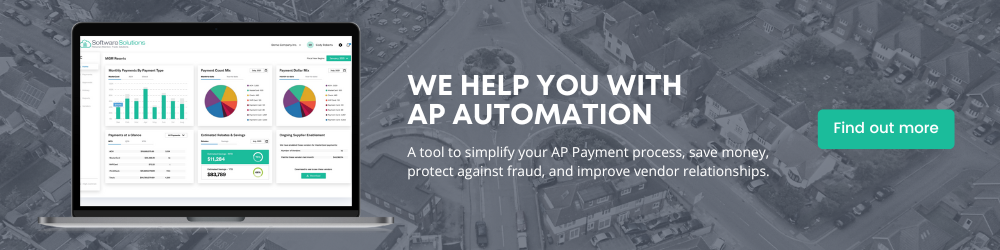
VIP AP Automation supports a procure-to-pay process built for the public sector. Instead of relying heavily on physical checks and manual steps, finance teams can select invoices ready to be paid and send them for processing. Payments are sent on the organization’s behalf, with reconciliation details provided once payment goes through.
The AP Payment Portal gives accounts payable teams access to insights on AP operations in real time, including monthly payment breakdowns by type and vendor engagement. The process creates a single workflow for AP payments, helping reduce errors and double-entry.
It can also reduce fraud risk because the organization doesn’t have to store supplier banking data. Vendors receive payment options, detailed remittances, and portal access for support and visibility.
For finance leaders, that kind of transparency is vital.
It helps answer basic but important questions:
-
Which invoices are ready to pay?
-
Where are payments in the process?
-
What payment types are being used?
-
How are vendors engaging?
-
Where can the process improve?
Transparent AP reporting helps your team move from reactive payment processing to more informed payment management.
Budgeting and Analytics Help Tell the Financial Story
A budget is more than a required document. It’s one of the clearest ways a local government communicates priorities, constraints, investments, and tradeoffs.
But communicating the budget well requires more than exporting numbers.
You need context. You need trend information. You need reports that show how departments, funds, and projects connect. You need the ability to adjust, review, and explain changes during the approval process. And you need to be able to explain your vision for the future.
VIP Budgeting & Analytics helps finance teams manage that work by bringing budgetary data into one system. Operational Budgeting supports organization-wide budget work. Personnel Budgeting helps teams budget wages and benefits by employee and pay code. Forecasting gives leaders a way to view multi-year trends and create what-if scenarios. Dashboards make key information easier to monitor.
There are options for delivering reports and financial plans in familiar formats, too. Automated Report Delivery allows reports to be shared through email or dashboards in PDF, Excel, or Word formats. It just makes things easier.
“With Budgeting & Analytics I was able to find, change, and update our financial statements within an hour or so. Analytics saved me a day of work, which is more than likely the amount of time I would have had to spend to just locate where the error was without it.”
-Jim C., Muskingum Watershed Conservancy District
That’s the kind of practical reporting improvement that makes transparency sustainable. Because when reporting takes too long, it’s harder to keep up.
This whole combination helps finance leaders communicate with different audiences.
-
Auditors may want detail.
-
Department heads may want quick access to budget status.
-
Elected officials may want clear summaries.
-
Residents may want to understand how public dollars support services.
The same financial data can support each of those conversations when it’s organized, reliable, and flexible enough to report in different ways.
Does Open Government Require Good Data Governance?
Open government is often discussed as a public-facing goal. Put more information online. Make data available. Give residents access.
Those are important goals, but they all depend on internal data governance. The Open Government Partnership notes, “At the local level, where governments directly deliver services to residents, the stakes are particularly high.”
If the underlying data is inconsistent, outdated, incomplete, or hard to interpret, publication alone won’t create trust. In some cases, it can create more questions.
Good transparency starts with dependable source data. That means financial information should be accurate, current, traceable, secure, and tied to the right workflows. It should also be available in formats that make sense for the audience.
ERP reporting helps by reducing the distance between transaction entry and final reporting. When data posts from connected modules, when workflows capture approvals, when reports pull from real-time information, and when documents are archived securely, finance teams have a better foundation for transparent communication.
That doesn’t mean every record belongs in a public portal.
Some information is confidential. Some information needs context. Some reports are designed for internal operations. Open government should balance transparency with security, privacy, and responsible access.
But the principle still holds: trustworthy reporting starts with trustworthy data.
So, How Does ERP Reporting Build Public Trust in Local Government?
Trust grows when people can see that financial decisions are documented, reviewed, and reported clearly.
As Tech Policy Press puts it: "Technology is essential to the future of good government and good governing, and Americans’ trust in these tools is essential to making sure government modernization benefits the public."
ERP reporting helps strengthen ERP public trust local government efforts by making financial data more accurate, accessible, and easier to explain.
And for finance teams, it connects several important pieces:
-
Accuracy: Financial data is captured and reported from connected accounting processes.
-
Timeliness: Reports can be generated from current information instead of waiting for manual updates.
-
Consistency: Standard and ad-hoc reports can be formatted once and reused.
-
Accountability: Workflows help document approvals, budget checks, and decision paths.
-
Accessibility: Dashboards, grids, publishers, and automated delivery help the right people get the right reports.
-
Audit support: Organized records and report access help reduce audit friction.
-
Fraud prevention: Tools like Positive Pay, encrypted signatures, approval workflows, and AP automation add layers of control.
-
Clarity: Reports can be shaped for different audiences, from auditors to elected officials to department leaders.
That’s the real value of ERP reporting.
It helps finance leaders move from confusion to knowing what happened, why it happened, and where to find support.
For local governments, that clarity is powerful.
It helps protect public dollars. It helps leadership make better decisions. It helps auditors do their work. It helps staff spend less time chasing information. And it helps residents see that their government is managing finances with care.
It builds trust.
VIP Accounting Gives Your Finance Team a Stronger Reporting Foundation
Finance directors, auditors, and treasurers need systems that match the complexity of public sector finance.
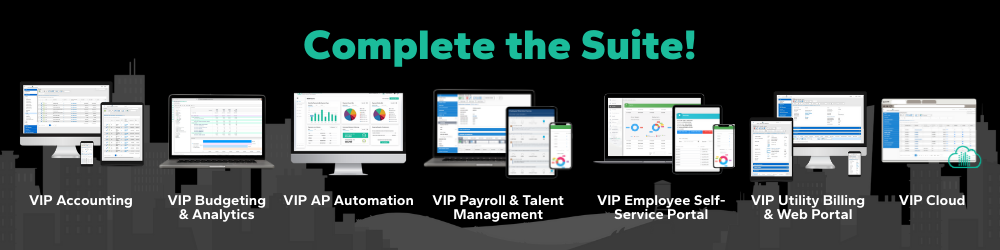
VIP Accounting and its add-on modules give local governments tools to manage fund accounting, purchasing, budgeting, AP, receipts, bank reconciliation, project accounting, capital projects, reporting, workflows, document generation, and analytics from a more connected foundation.
That connected foundation supports better financial transparency because it helps your team:
-
Track activity by fund, department, project, grant, or account structure
-
Manage purchasing approvals and budget checks
-
Create reports for leadership, auditors, and departments
-
Use dashboards to monitor key financial data
-
Automate report delivery in PDF, Excel, or Word
-
Reduce manual spreadsheet work
-
Store and retrieve supporting documents more easily
-
Improve visibility into vendor payments and AP activity
-
Protect financial documents with secure signatures and Positive Pay options
-
Support audit readiness with cleaner access to data and documentation
Trust doesn’t happen because a transparent report exists.
It happens when financial information is accurate, accessible, explainable, and useful.
That’s the kind of reporting foundation local governments need to build confidence with residents, elected officials, councils, and staff.
And when your finance team has better tools, public trust has stronger roots.
Explore VIP Accounting to see how SSI helps local governments turn financial data into clearer reporting, stronger internal controls, and more transparent decision-making.
Related Posts
Florida Senate Bill 4-F and House Bill 1329 Explained
Florida's 2026 Special Session produced two pieces of legislation that will affect nearly every...
The True Cost of Local Government ERP Software
When local government leaders begin evaluating new ERP software, the conversation almost always...
How to Talk to Your Council About Local Government ERP Software
If you’re looking to modernize your city, county, or township’s financial and administrative...