

8 min read
Winning the Government Finance Officers Association (GFOA) Distinguished Budget Presentation Award takes more than submitting a technically complete budget document. Reviewers want to see a budget that clearly communicates policy direction, financial condition, operational priorities, and public value.
If you're preparing a submission, treat the budget as both a financial document and a communication document. Under the current framework, applicants need to earn more than 100 points across the evaluation criteria. When done right, success comes from presenting complete information, organizing it clearly, and making every required element easy for reviewers to find and verify.
How does the GFOA evaluate budgets?
GFOA evaluates budget documents based on how well they serve four roles:
-
Policy document: Explains strategic priorities, major initiatives, and governing body direction.
-
Financial plan: Presents revenue structure, expenditure planning, fund balances, long-range projections, and major obligations.
-
Operations guide: Shows how departmental budgets, staffing, and service levels support day-to-day operations.
-
Communications device: Makes complex financial information understandable to elected officials, staff, and constituents.
A strong submission performs well in all four areas. If one area is underdeveloped, the overall document becomes less competitive.
What do I need before I apply for the GFOA Distinguished Budget Presentation Award?
You need to confirm eligibility and timing, then gather the necessary materials. The application process is more straightforward than many local government finance teams expect, but it still requires careful preparation. The strongest submissions are complete and organized so reviewers can quickly confirm how the document meets the criteria.
Confirm eligibility and timing
Before starting the application, confirm that your local government or public sector organization is eligible to participate. The program is open to a wide range of entities, including states, cities, counties, school districts, special districts, and retirement systems. Applicants may submit either a proposed budget or an adopted budget.
Timing matters, too. Budget documents generally need to be submitted within 90 days of adoption or approval. If your team cannot meet that timeline, review the current extension process before the deadline passes.
Gather your materials
Before opening the online application, have the core materials ready. In most cases, that includes:
-
Answers to the GFOA's budget questions about community priorities, long-term outlook, revenue budget, personnel budget, department budget, budget process, and more.
-
Answers in the right format: "GFOA will accept websites, budget-in-brief, presentations, videos, or other formats that clearly answer the budget questions."
-
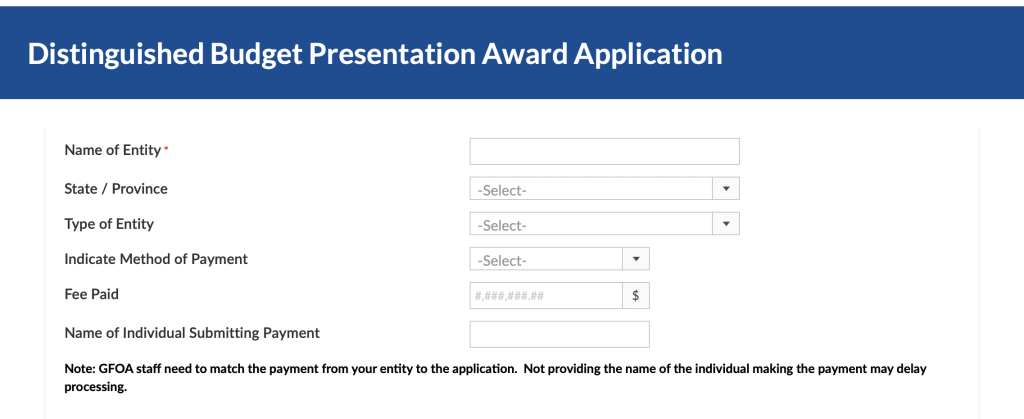
A payment method for the application fee
-
Your completed Criteria Location Guide
Application fees vary based on the type and size of the entity submitting. Because fee schedules and requirements can change, it's worth confirming the latest details before you submit.
How do I apply for the GFOA Distinguished Budget Presentation Award?
For many finance teams, the most effective approach looks like this:
-
Review the current GFOA criteria in full. Identify both the scored elements and the mandatory requirements.
-
Assess your current budget document against those criteria. Note where narrative, structure, or supporting detail is incomplete.
-
Revise the document section by section. Strengthen explanations, improve organization, and add supporting visuals where helpful.
-
Prepare supplemental communication materials. If you're including a Budget in Brief, webpage, or multimedia component, make sure each one supports the same budget story.
-
Complete the Criteria Location Guide and final review. Confirm that reviewers can easily verify every requirement.
What are some tips for constructing the budget presentation?
A common mistake is spending too much time on formatting while leaving key narrative sections underdeveloped. Reviewers are looking for substantive content that answers core public-sector questions.
1. Community priorities and organizational challenges
Explain the major issues facing your local government during the budget period. That may include infrastructure needs, staffing pressures, revenue uncertainty, service demand, inflation, or capital obligations. Then show how the proposed budget addresses those conditions and what measurable outcomes are expected.
2. Value and revenue outlook
Describe what constituents receive for the public resources being allocated. Break down major revenue sources, explain how those revenues are distributed, and clarify the degree of local control over those funds.
3. Long-term fiscal outlook
Present multi-year financial trends and explain what they mean. This section should address reserve levels, structural balance, long-term liabilities, debt service, and deferred operating or capital needs where applicable.
4. Department and program budgets
Connect expenditures to services, goals, and performance expectations. Department sections should explain what each area is responsible for, how resources are being used, and what outcomes or service levels are expected.
5. Capital and staff planning
Document how capital projects are prioritized and how staffing changes affect the budget. Include project selection criteria, capital thresholds where relevant, major personnel cost drivers, and total staffing levels with enough context to make those numbers meaningful.
6. Budget process and public involvement
Outline the full budget development process, including internal preparation, executive review, governing body action, and opportunities for public participation. A clear timeline strengthens this section.
Prioritize the mandatory criteria
One of the most important parts of the application process is confirming that every mandatory criterion has been addressed. A document may be well written and visually strong, but a missing required element can keep the submission from succeeding.
Review the full criteria before making final edits. Focus on substance as much as presentation. Ask whether the document clearly explains policy choices, revenue assumptions, operational priorities, long-term outlook, and the value delivered to the community.
Before submitting, conduct a structured review and verify that each required item is present, complete, and easy to locate. This includes confirming that page references, section references, and supporting links are accurate.
Use the Criteria Location Guide carefully
The Criteria Location Guide is one of the main tools reviewers use to evaluate your application efficiently.
For each criterion, identify the exact page number, section heading, or link where the requirement is addressed. Avoid broad references that force reviewers to search through the document. The clearer your cross-references are, the easier it is for reviewers to confirm compliance.
For many teams, this step also serves as a final quality-control check. As you map each criterion back to the document, gaps become easier to spot and fix before submission.
Pay close attention to presentation categories
GFOA also evaluates how effectively budget information is presented. A complete submission should not rely on technical accuracy alone. It also needs to present information in a way that is accessible and organized.
Primary budget document
The main budget book should be logically organized, easy to navigate, and written in clear language. Tables, charts, and summaries should support understanding rather than add complexity.
Budget in Brief or newsletter
A concise summary document can strengthen the overall presentation by giving readers a shorter, more digestible version of the budget's key decisions and financial highlights.
Interactive web presence and multimedia
Digital budget pages, dashboards, and video summaries can help explain complex topics more clearly and improve accessibility for public audiences. If these materials are part of your submission, they should align closely with the core budget narrative.
Practical strategies that improve your chances
Several practices consistently strengthen submissions:
-
Start with the criteria and outline your document structure around them.
-
Verify that each of the four document roles is clearly represented.
-
Use plain language in narrative sections, especially where public understanding is essential.
-
Support major financial explanations with charts, tables, and summaries when they improve clarity.
-
Tie departmental and capital spending to goals, service levels, and measurable outcomes.
-
Review the full document for consistency across narrative sections, tables, and appendices.
-
Complete a final compliance review focused on mandatory items and citation accuracy in the Criteria Location Guide.
What happens after submission?
After submission, your budget document is reviewed by trained reviewers. If issues are identified, you may have an opportunity to make corrections and resubmit.
That's part of what makes the program valuable. The review process does more than evaluate the document. It also helps finance teams strengthen future budget presentations.
If your submission earns the award, you can use that recognition as a signal of transparency, accountability, and strong financial communication. For many local government finance teams, that recognition supports trust with governing bodies and the communities they serve.
Final consideration
A competitive GFOA submission is clear, complete, and reviewer-friendly. The goal is not only to include all required information, but to present that information in a way that demonstrates sound financial planning, operational understanding, and effective public communication.
When the document is structured around the criteria and supported by precise cross-referencing, your application is in a much stronger position.
Where VIP Budgeting & Analytics can help
If you're doing all of this in spreadsheets, separate files, or a patchwork of reports, you're probably going cross-eyed already. Building a budget document that is complete, accurate, and reviewer-friendly takes more than good writing. It also takes current data, clear trends, consistent departmental inputs, and reporting you can trust.
That's where VIP Budgeting & Analytics comes in. It gives local government finance teams a centralized place to manage budget data, work through line-item requests, review multi-year trends, and build forecasts in real time. You can connect departmental input, personnel budgeting, reporting, and dashboards in one process instead of chasing updates across disconnected files.
This is vital when you're preparing a GFOA submission. Strong budget presentations depend on clear explanations, reliable financial data, and visuals that support the story you're telling. With VIP Budgeting & Analytics, your team can move faster from assembling numbers to explaining what those numbers mean for staff, leadership, and constituents.
If your goal is to produce a budget document that is easier to build, easier to review, and stronger in front of GFOA evaluators, VIP Budgeting & Analytics is built for that kind of work.