

12 min read
A customer walks up to the counter with a question about their bill.
The bill looks higher than expected. The customer is frustrated. The billing clerk starts digging through account information, rate tables, and usage history to find answers.
Most utility offices have experienced a version of this conversation.
But what if the real solution isn't improving complaint handling? What if it's preventing the confusion before the bill is ever generated?
For many local governments, some of the most common utility billing errors don't begin at the front counter; they begin during utility rate code setup, account configuration, or ordinance implementation.
The good news is that most of these issues are preventable with a few simple processes, regular audits, and clear communication practices.
Let's look at what experienced utility finance teams do to reduce billing problems before they become customer calls.
Why Rate Code Setup is Complicated
Utility billing is rarely just a single, standard rate. Most municipalities manage combinations of:
-
Residential and commercial classifications
-
Inside-city and outside-city rates
-
Meter-size-based charges
-
Tiered consumption pricing
-
Sewer averaging rules
-
Stormwater fees
-
Capital improvement surcharges
-
Late fee and penalty structures
Every one of these rules has to be translated from the ordinance into the billing system. And when that setup is done correctly, billing runs smoothly. (Yay!)
When it's not, employees spend too much time researching questions, adjusting bills, and handling customer concerns instead of focusing on higher-value work. (Booo!)
Many local governments have spent years relying on manual reviews and time-consuming validation processes to catch these types of issues. But you don't have to be one of them.
Track The Warning Signs
Sometimes the first sign of a rate configuration issue is more operational, and not so technical.
Watch for these trends:
-
Increased call volume
-
More bill adjustments
-
Growing numbers of credits
-
Repeat questions about a specific charge
-
Multiple complaints from the same customer class
-
Staff escalating routine billing questions
These can reveal underlying setup issues long before someone identifies the specific rate code responsible.
A well-managed utility rate code setup reduces corrections, saves staff time, builds public trust, and just makes life easier for everyone involved, from the Finance Director to the billing clerk at the front counter.
Try a Monthly Rate Code Audit
One of the simplest ways to reduce utility billing errors is to do a short monthly review. You don't need to audit every account; you only need to review the accounts most likely to generate problems.
If you're looking for errors now, here's where they often hide:
-
Customer Classification
A surprising number of billing issues trace back to account classification. Look for:
-
Commercial accounts that are assigned residential rates
-
Inside-city customers coded as outside-city customers
-
Seasonal accounts using year-round billing rules
-
Multi-family properties that are assigned incorrect rate classes
Even if the rate table itself is correct, the wrong account assignment can create inaccurate bills month after month.
-
-
Meter Size Assignments
A lot of municipalities base fixed charges on meter size. But a 1-inch meter charged at a 5/8-inch rate might generate lower revenues than intended. And a residential account that's assigned a larger-meter rate can cause some customer complaints immediately. Whenever a meter is replaced or upgraded, make sure that the account configuration is updated at the same time.
-
Effective Dates
Rate increases and ordinance changes normally take effect on a specific date. So make sure to review:
-
New rate schedules
-
Mid-cycle changes
-
Proration settings
-
Legacy rates that should have been retired
Even a small date-entry mistake can impact hundreds of accounts at once. (Alarming to think about, we know...)
-
-
Sewer Averaging Rules
Winter Quarter Averaging and sewer caps help many customers avoid paying sewer fees on outdoor irrigation. Because these calculations often happen automatically, they can be overlooked until a customer notices a significant change. Review averaging calculations every year and verify that updates occurred as expected.
-
Add-On Charges and Surcharges
A lot of customers have questions about:
-
Infrastructure fees
-
Capital improvement charges
-
Debt service fees
-
Stormwater assessments
These charges may be completely accurate, but they can still create confusion if they're not clearly identified and explained. Communication is important!
-
So, for your monthly self-audit, try out this checklist of things to review:
-
New accounts added during the previous month
-
Accounts with recent rate code changes
-
Commercial and industrial accounts
-
Outside-city customers
-
Meter replacements
-
Zero-usage accounts
-
Accounts with unusually high increases
-
Accounts requiring recent bill adjustments
-
Accounts generating multiple customer inquiries
-
Residential Users as your High Users for the period (Indicates a leak or misread)
Regular audits help identify small issues before they become larger correction projects. Similar audit practices are commonly recommended in operational workflows. Because catching problems early is significantly less expensive than correcting them later. (Just ask around.)
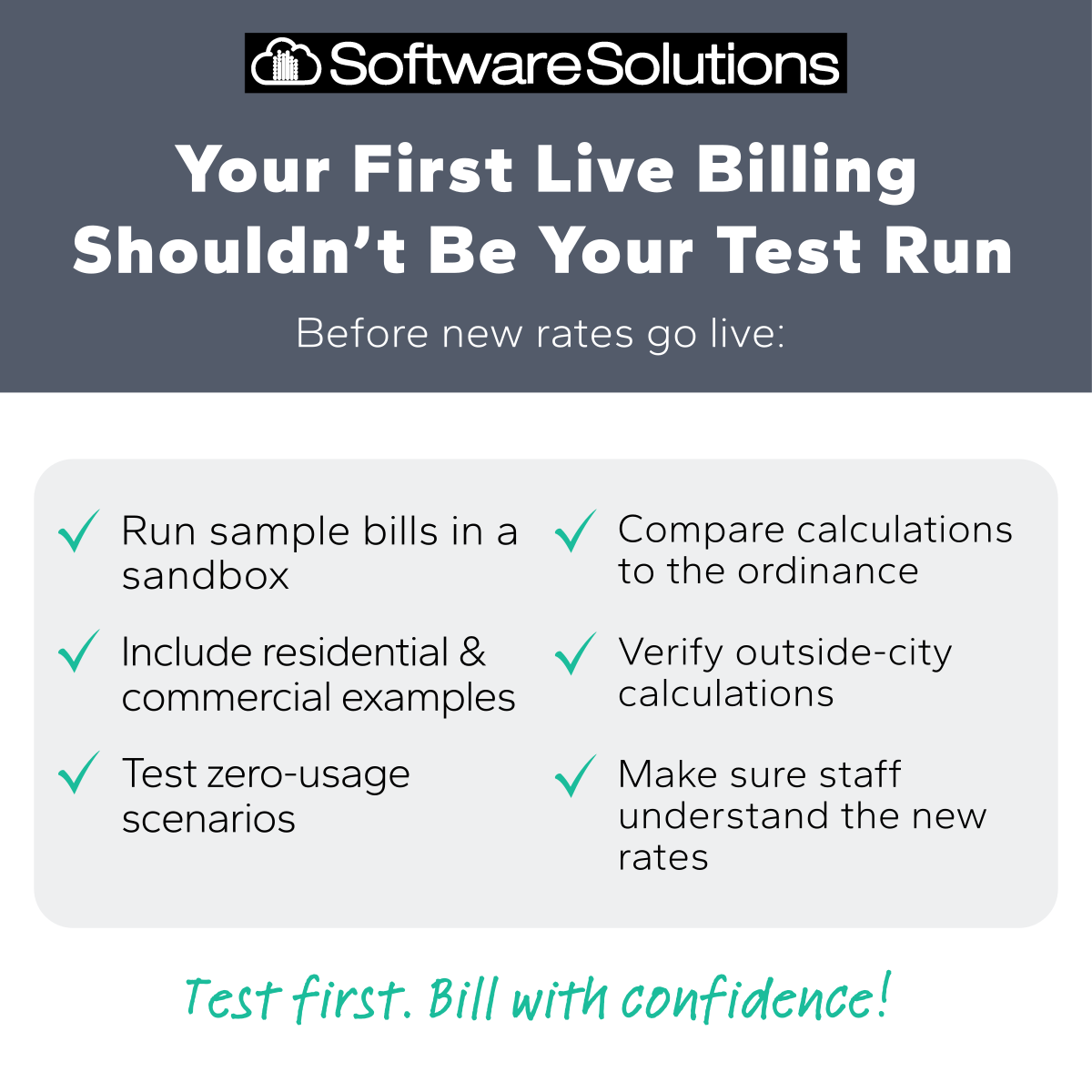
Run Test Bills Before Major Rate Changes (Please)
Think of rate changes the same way you would think about software updates... You wouldn't want your first live billing to also be your test run.
So before implementing new rates:
-
Test existing accounts in a sandbox environment
-
Run sample bills
-
Compare calculations against the ordinance
-
Include residential and commercial examples
-
Include special rate classes
-
Verify outside-city calculations
-
Test zero-usage scenarios
-
Make sure your UB personnel understand the rates and how they work
If you have a sandbox, this is much easier to do. But make sure it is updated with the most recent data. Testing before go-live helps your staff become familiar with the setup and identify issues before actually billing. It's a great way to train your employees, too.
Train Staff to Explain Bills
Even perfectly calculated bills generate questions. It's a product of the human mind. So the goal is not to eliminate every customer call. That's impossible!
The goal is to make these conversations easier.
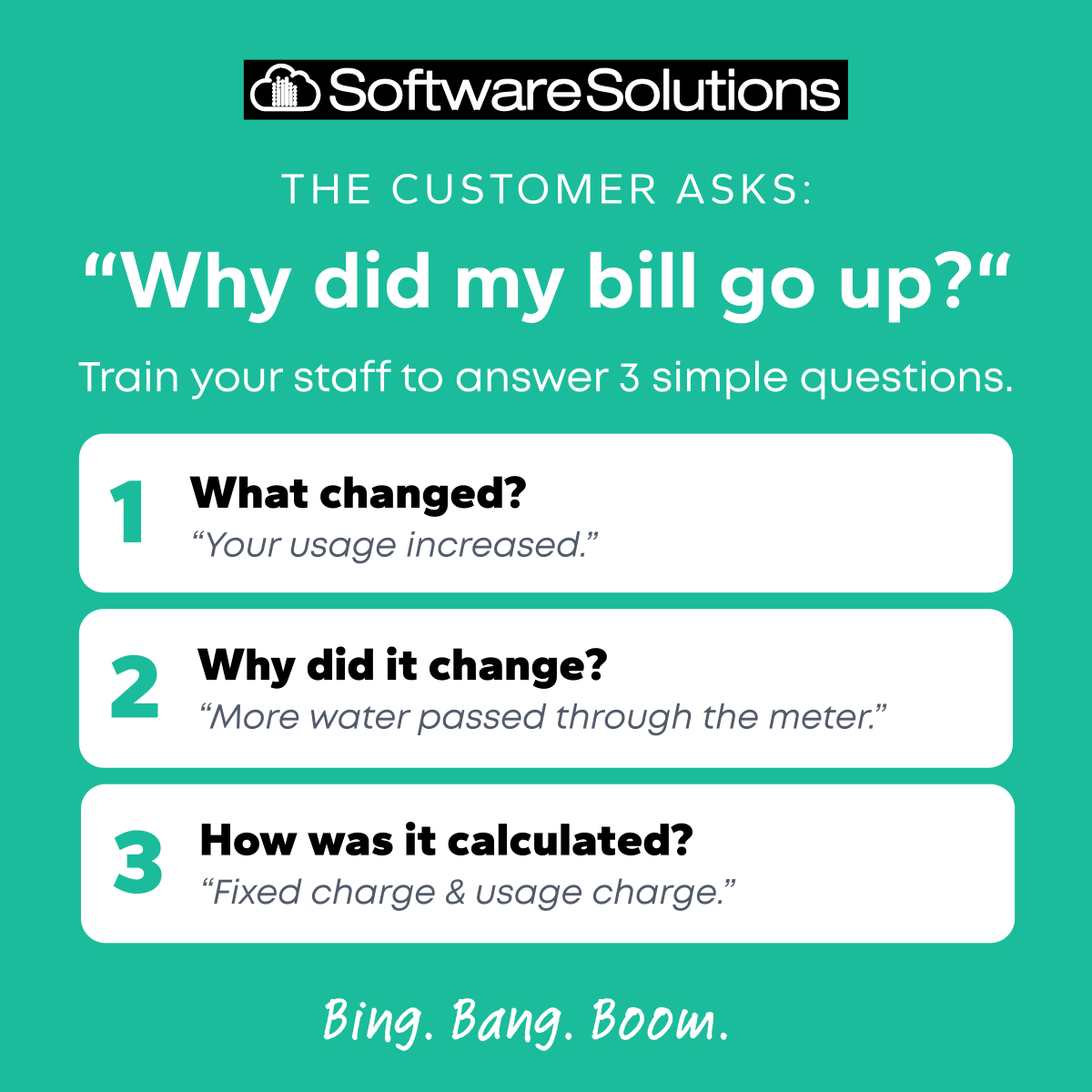
One useful approach is a simple 3-question framework that employees should be able to answer:
-
What's changed?
-
Why did it change?
-
How was it calculated? (Just the basics; don't get too technical.)
For example, someone might call in and ask, "Why did my bill go up?" By following the framework, your employees could answer this way:
-
"Your usage increased compared to last month." (What's changed?)
-
"Your account moved from winter sewer averaging to actual usage."
(Why did it change?)
-
"The first portion of usage is billed at one rate, and the remaining usage is billed at a different rate." (How was it calculated?)
Now all that's left is to put in some filler language for a better customer experience. So let's role play:
-
Customer: "My water bill is way higher than normal. There has to be a mistake."
-
Utility Employee: "I'd be happy to take a look. Can you tell me what seems different compared to your usual bill?"
-
Customer: "It's almost forty dollars higher than last month. Nothing has changed at my house."
-
Utility Employee: "Okay, let's look at the account together. Can you tell me your account number..."
-
Customer: *Gives account info*
-
Utility Employee: "Thanks for waiting. I can see what's different. So let's walk through it here. The biggest change is that your water usage increased this month. Last month you used about 4,000 gallons. This month you used about 8,500 gallons. So the bill increased because more water was used during this billing period. [What's changed?]
-
Customer: "Wow. I didn't realize it was that much higher..."
-
Utility Employee: "There are a few common reasons we see this happen. This billing period covered several weeks when many people decide to water lawns, fill pools, and water their gardens. But I can also see that your meter readings appear to be working correctly and there weren't any billing adjustments made to the account. So based on what I'm seeing, the higher bill is tied to higher water consumption rather than a billing error." [Why Did It Change?]
-
Customer: "So you're saying I actually used that much water?"
-
Utility Employee: "Based on the meter readings, yes. If you'd like, you can also check for things like a running toilet or an outdoor leak. Those are some of the most common causes of unexpected water usage."
-
Customer: "Okay, but how did that turn into a bill over X dollars?"
-
Utility Employee: "Great question! Your bill has two main parts. The first is a fixed monthly service charge. Every customer pays that amount regardless of usage. The second part is the usage charge. You used 8,500 gallons this month. The first portion of that usage is billed at one rate, and usage above that amount is billed at a different rate. So while your usage didn't double exactly, more of your water fell into the higher usage tier, which increased the total bill." [How Was It Calculated?]
-
Customer: "Okay, I still don't like it."
-
Utility Employee: "I know utility bills can be difficult. But what I'm seeing is that the bill was calculated correctly, and your usage increased significantly during this billing cycle."
-
Customer: "Yeah. Maybe I'll check to see if I have a leak anywhere."
-
Utility Employee: "That's a great idea! If you'd like, I can also help you compare the last several months of usage or discuss some ways to monitor or lower your consumption going forward."
-
Customer: "Sure, we can do that."
-
Utility Employee: "Absolutely. Let's take a look..."
While we may have gone overboard with the dialogue, it still shows how this structure helps employees explain bills clearly without immediately overwhelming customers with technical details.
Notice that the utility employee didn't start quoting ordinances, reading the rate tables line-by-line, tell the customer they're wrong, explain complicated rate structures, or use technical jargon.
Instead, the employee answered the 3 questions:
-
What changed? - Your usage increased.
-
Why did it change? - More water passed through the meter.
-
How was it calculated? - Fixed charge + usage charge based on the adopted rate structure.
Bing. Bang. Boom. By the end of the conversation, the customer still probably won't like the bill, but they'll understand it. And that's usually the difference between ending a conversation with frustration versus ending it with trust.
(And as a side note, these conversations will be easier for some employees more than others. There's a lot of turnover in the public arena, so creating a billing explanation cheat sheet might help new hires.)
How We Can Help
We built VIP Utility Billing to help utilities and local governments manage the entire billing lifecycle, from account inquiry and rate management to work orders, meter tracking, payment plans, and customer communications. Features like high/low bill alerts, rate history tracking, automated rate changes, approval workflows, and customer self-service through the VIP Web Portal help your staff identify issues earlier and answer customer questions more confidently. The result is less time spent chasing problems and more time serving your community.
Just as important, you'll be backed by a team that understands the public sector. SSI has worked exclusively with public organizations since 1978, and many members of our support team have firsthand experience in government operations. Whether you need help with rate setup, billing procedures, reporting, or day-to-day questions, we're here as an extension of your team. Most support tickets are resolved the same day, and our habit of resolving most tickets in under 2 hours reflects our commitment to helping utility departments work more efficiently.
So, if you want a partner, not just an ERP vendor, give us a call.
Related Posts
The Funnel Effect with Gary Sanders
Guest post written by Gary Sanders.
Does this scenario sound familiar?
A member of your staff gives...
Solving Utility Issues with Experts
You’re grappling with an unpredictable postal service, the rising tide of check fraud, and the...
Local Government ERP Cost: Implementation & True TCO
When local government leaders begin evaluating new ERP software, the conversation almost always...